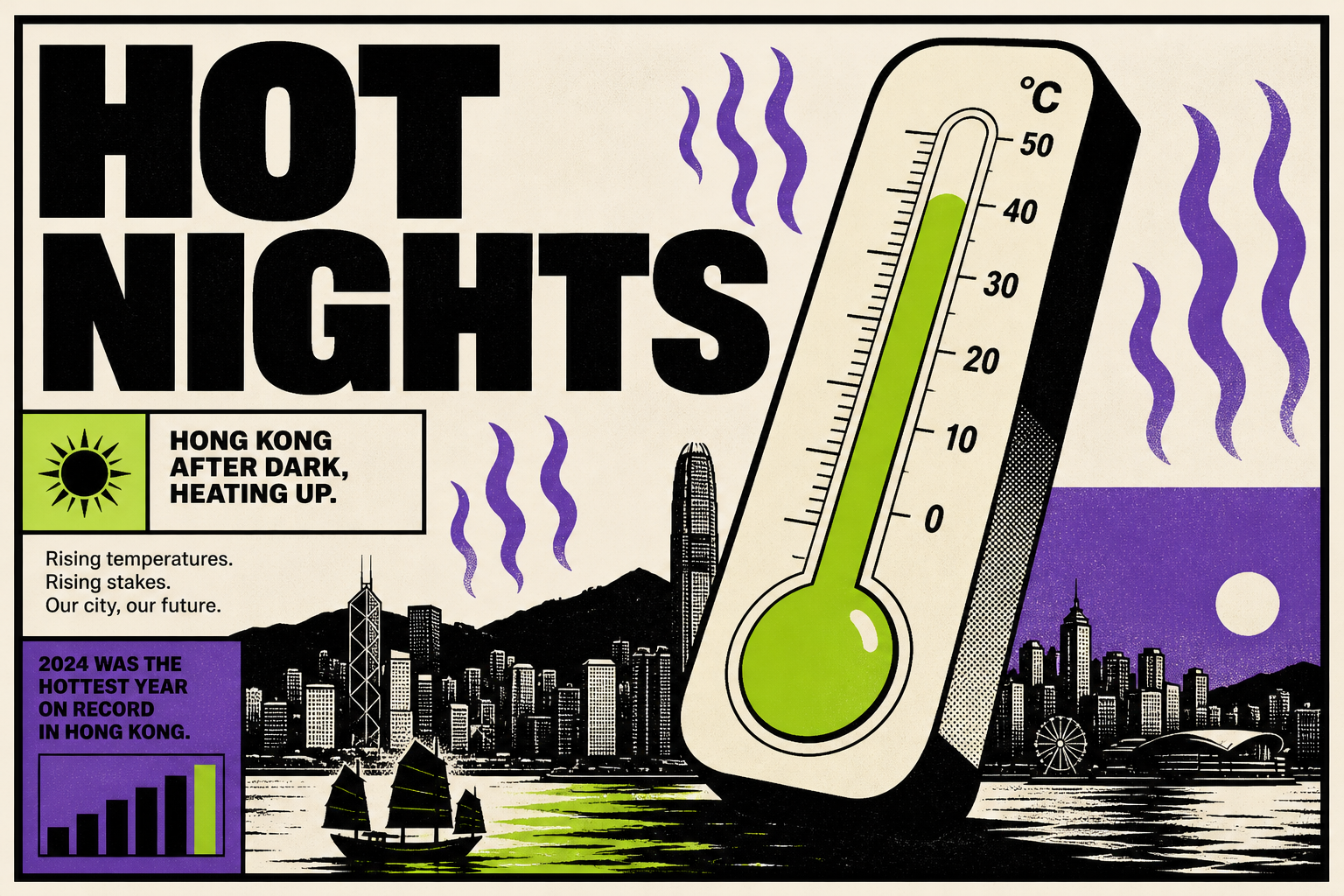
Climate is for real — 10 Asia/HK facts already landing
Not doom porn. Heat, harbour, humidity, and systems that treat climate like ops.
Ten concrete beats for Hong Kong and Asia that are already on the books — projections, microclimates, and policy that treats heat like operations.
1. Extremely hot days used to be almost theoretical
HKO baseline 1995–2014: 0.2 extremely hot days a year (max ≥ 35°C). Under high-emissions SSP5-8.5, mean for 2081–2100 jumps to 69 (likely 47–112). Intermediate SSP2-4.5: about 16 (6–32).
2. “Very hot” could own half the year (high emissions)
HKO’s CMIP6 ensemble: average annual very hot days near ~150 late-century under very high emissions — always label the SSP.
3. Sea level: centimetres to about a metre this century
Vs 1995–2014, HK mean sea level in 2100 likely 0.37–0.82 m higher under SSP2-4.5, or 0.57–1.08 m under SSP5-8.5 (Quarry Bay).
4. Familiar typhoon tracks, nastier storm surges
Same HKO note: rising mean sea level lifts tropical-cyclone storm-surge risk; rare extreme water levels get less rare.
same MSL page as #3
5. Wetter years, not just hotter ones
Annual rainfall 2081–2100 vs 1995–2014 (2456 mm at HKO): about +7% (SSP2-4.5) and +9% (SSP5-8.5).
6. Same morning, same district — up to 4°C apart
11:00 on 28 Jul 2022: Observatory HQ garden vs a Mong Kok urban station (both Yau Tsim Mong) differed by up to 4°C. Your street’s surfaces rewrite the forecast.
HKO urban temperature monitoring
7. Humidity maps change the danger zones
High-res work on HK’s urban moisture island: heat-stress maps that ignore humidity can underpredict risk — one modelled case flipped large areas from “fine on temp alone” into Extreme caution / Danger once humidity joined. Science nerd fact, not a panic button.
8. Workplace heat warnings — then the ladder moved
Labour Department (27 Aug 2026; effective 28 Aug) enhanced the three-tier Heat Stress at Work system (Amber/Red/Black): when HKO’s “Extremely Hot Weather” Special Alert is in force, the bar for a higher warning drops; when measured temperatures generally over Hong Kong hit 35°C or above, the warning rises one level automatically (Amber→Red / Red→Black) and the monitoring threshold lowers too. System since 2023; from Apr 2026 LD also pulls HKHI from nine stations beyond King’s Park.
9. Singapore runs heat like national ops
Early 2025: national heatwave plan + Heat Resilience Policy Office; 300+ cooling centres when a heatwave is declared; myENV alerts ≥4 days ahead; S$40m heat-adaptation R&D call targeted by end 2026. Third National Climate Change Study (via ST): by 2050, 47–189 days/year could exceed 35°C; ≥317 warm nights.
10. Southeast Asia: extreme heat stress as background weather
2025 Scientific Reports: extreme heat-stress exposure rises strongly across Indonesia, Vietnam, Thailand and neighbours under warming — some of the most exposed places still lag on early-warning systems.
doi:10.1038/s41598-025-28817-6
Close: Not despair — the numbers are already policy inputs. Cooling centres, warning redesigns, HKO scenarios aren’t “someday.” They’re the brief.